
To be able to develop the concept of tension more and more, we should look at different examples where a rising tone is used to instill a feeling of tension, and analyze in what context these are used and investigate whether there are other elements that occur as means to reinforce the feeling of tension. The question we must ask ourselves is how do we find pieces that fulfill the requirement regarding tension? We could make a selection of a large number of works and then apply the above requirements to these and thereby filter out the works that do not contain phonetens. However, this is a time-consuming method that also lacks one of the most important factors in a work that expresses tension, namely the creator’s intentions. If the creator has not had the goal of producing a work that leads to tension, should we then dismiss these as well? To avoid this problem, we can look up creators who discuss this phenomenon in their works, instead of looking up works that we have to analyze without knowing whether they are meant to represent tension.
Where is tension found?
Where do we start looking for creators who discuss this? We should stick to an area where tension is a component that occurs to the greatest extent possible. An area that benefits from a sound design that strives to build up tension and expectation in the recipient. A dramatic curve is a general representation of how a narrative flow is usually carried out. We can see in the image below how the red thread escalates in the process, it shows how intensity increases with time.
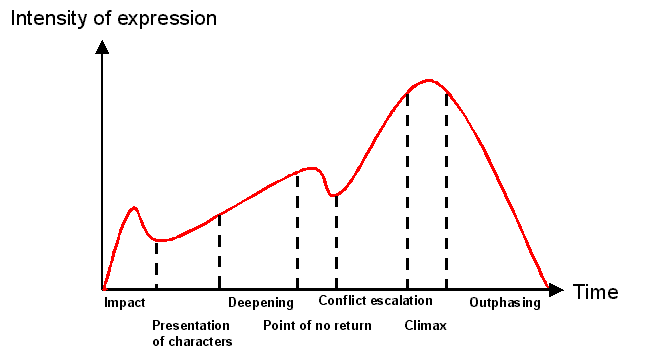
The curve is widely occurring in filmmaking where building tension is the engine in film genres that stretch between everything from horror/thriller to action and even drama. A pioneer of tension in filmmaking explains this as follows:
“There is a distinct difference between “suspense” and “surprise,” and yet many pictures continually confuse the two. I’ll explain what I mean.
We are now having a very innocent little chat. Let’s suppose that there is a bomb underneath this table between us. Nothing happens, and then all of a sudden, “Boom!” There is an explosion. The public is surprised, but prior to this surprise, it has seen an absolutely ordinary scene, of no special consequence. Now, let us take a suspense situation. The bomb is underneath the table and the public knows it, probably because they have seen the anarchist place it there. The public is aware the bomb is going to explode at one o’clock and there is a clock in the decor. The public can see that it is a quarter to one. In these conditions, the same innocuous conversation becomes fascinating because the public is participating in the scene. The audience is longing to warn the characters on the screen: “You shouldn’t be talking about such trivial matters. There is a bomb beneath you and it is about to explode!”
In the first case we have given the public fifteen seconds of surprise at the moment of the explosion. In the second we have provided them with fifteen minutes of suspense. The conclusion is that whenever possible the public must be informed. Except when the surprise is a twist, that is, when the unexpected ending is, in itself, the highlight of the story.”
Alfred Hitchcock expressed himself this way during an interview that was documented in the book “Hitchcock” (F. Truffaut, H. G. Scott 1967). In a video, the same version is documented in similar form:
Alfred Hitchcock understood that buildup is one of storytelling’s most important principles for getting a recipient involved in the narrative. In this investigation, however, the interest lies in how the modern sound designer exploits this principle.
Modern example
We can therefore look for an example that fulfills the following requirements: The work should have been created for the purpose of representing the narrative in a film; The work’s creator should have discussed how tension has been represented in the work; The work should contain a rising tone in accordance with previous posts in this blog; The work should not be older than 10 years since the creator has had similar conditions as exist with today’s technology, tools and equipment.
One of the most influential creators in modern film music is composer Hans Zimmer (http://www.imdb.com/name/nm0001877/awards?ref_=nm_ql_2) who at the time of writing has been awarded 75 distinctions for his various works. In 2009, he had the assignment together with James Newton Howard to compose music for The Dark Knight. The process has been documented in a compilation of various interviews where the creators of the film discuss the production of the music track for The Dark Knight:
The original attached video is no longer available, but I found this newly published interview with Hans Zimmer that discusses the Joker’s Theme in the same spirit. The following text, however, refers to the original video.
In the clip, the work “The Joker Theme – Why So Serious?” is discussed, which is meant to represent an unpredictable character with anarchistic ideas. Despite the interviews being taken out of context, it’s possible to find some essential bits that explain how this piece was shaped with the goal of building up tension and uncertainty around the film’s antagonist:
0:57 Christopher Nolan (Director) discusses how Hans Zimmer talked about ideas built around the concept of tension (“extraordinary tension”) that escalates more and more.
3:50 Hans Zimmer clarifies that the Joker’s theme should represent the character’s distinctive features and means that he found this by letting two tones from different cellos resonate in dissonance with each other, and simultaneously raise the tones so that it gave the impression that the strings become increasingly tense without reaching the breaking point.
4:39 Christopher Nolan discusses once again the rising feeling of tension, and how this manifests very weakly at first.
5:00 Hans Zimmer describes how he gave instructions to the musicians to start very softly and then slowly increase the intensity in the performance.
5:56 Hans Zimmer talks about how the piece should give the impression of being very intimate, and discusses how this should go hand in hand with the portrayal of the Joker’s character in the film.
We have here clear signs that the work’s creators have been fully aware of how the rising tones have been a tool for shaping the tension around the character that is reflected in the music.
The Joker’s Theme
In the introductory post, we call for more elements than just a rising tone as possible phonetens. The Joker’s theme therefore fits in as a good starting point for understanding what other elements can be classified in the same category of phonentesious sounds. The next post will contain an analysis of this theme where we stack up the work’s different components.
My name is Jacob Westberg and I am a game composer, software developer, and educator of game audio. You can find topics here surrounding creative work in game music that I find insightful and interesting to research.

In order to share my research with others for free, all articles on this website will be open and accessible for anyone. You can support this open research by subscribing to my Patreon.